Product Updates

Text strings now supported for Matrix Model Axis Headers

Alloy has introduced the ability to use text strings as the Axis Headers within Matrix Models for Credit Underwriting.

If your credit policy includes calculating a credit line assignment or APR using a two dimensional grid or matrix, Alloy’s Matrix Model feature is a great way to easily handle this logic.

We have expanded our existing Axis Header configurability options to now support the following:

Ranges (FICO Score): 300-500, 500-700, 700-850

Strings (Tier): Low, Medium, High

Webhooks authentication modal now available with support for OAuth 2.0

Alloy added a designated “Authentication” section to the webhooks modal and added support for a new authentication type - OAuth 2.0 client credential flow. With this addition, we now support No Auth, Basic Auth, and OAuth 2.0.

When you create a webhook (or edit an existing webhook), there is now a section to select “authentication type”. You can select None, Basic or OAuth 2.0.

Webhook 1
Webhook 2

Measure impact of transaction monitoring rules before going live with new What-If feature

New What-If functionality is available for Transaction Monitoring.

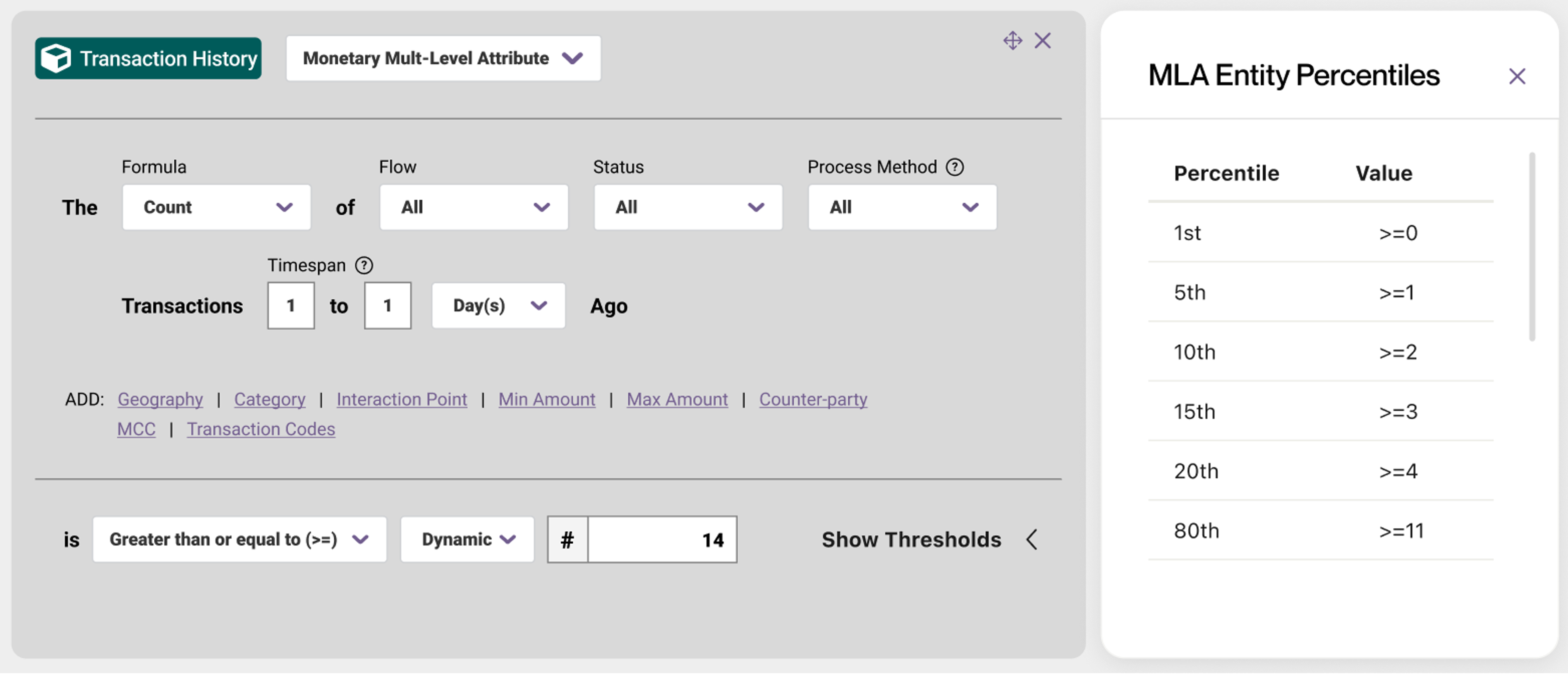
The What-If feature allows you to review the impact of any rule or scenario before pushing it out to production and alerting your customers. Try out different scenarios and thresholds, understand which entities would be triggered with the updated logic, and minimize false positives by only capturing the activity you're concerned about.

If you’d like to try or learn more about the What-If feature for Transaction Monitoring, reach out to your CSM or [email protected].

Use Journeys for document verification step ups

For clients using Journeys, Alloy will now handle the transition and state management of an Entity between workflows and document verification step ups for you.

Read more about Journeys on our blog. If you’d like to try Journeys, reach out to your CSM or [email protected] to learn more.

Decision on shared identity elements

Alloy is now offering the ability to decision off of identity elements (like SSN, phone number, email, etc.) when they are seen across multiple entities. This is an important step Alloy is taking to proactively prevent fraud. An example scenario would be detecting entities that share a SSN or phone number, then taking subsequent actions—such as tagging it informationally, running additional services, or determining an outcome.

For full details on how to use this new feature, see our support article.

Dashboard webhooks now do exponential backoff retries

Dashboard webhooks now all do exponential backoff retries. Prior to this, some webhooks did not do this. The following webhooks now also allow for retry:

  • Manually Review an Entity
  • Manually Review an Group
  • Create new notes for Entities, Evaluations, Reviews, and Documents

Alloy now has consistency across all our webhooks.

Outcomes can now be deleted

Previously Outcomes (e.g., Approved, Denied, Manual Review) could not be deleted once they were created. Once an Outcome is deleted, it will be removed from the outcomes dropdown on the following pages:

  • Evaluations
  • Entity
  • Workflow Editor
  • Review Queue
  • Review Reason when manually reviewing an entity

To delete an Outcome, go to Settings > Outcomes and click the trash can symbol next to the Outcome you would like to delete.

If an Entity had previously been assigned a deleted Outcome, nothing will change for that Entity. The deleted Outcome will still be reflected for that Entity.

Permissions will be set so that any agent that can create Outcomes can also delete them.

Create new outcome
Delete outcome

Filter by partner ID now available

Partner banks can now filter by "Partner ID" within the Evaluation view and Review Queues in the dashboard.

Alloy now accepts an identifiers.external_partner_id field in the API that we associate with Partner Customers. Partner Customers can filter by Partner ID on the Review Queue, Evaluations page, and Entity page by clicking on the "+" icon on the filter list. This is our recommended best practice for all partners.

Filter by partner ID image
JSON image
Back