New Features

Calculate APR and credit line assignment values with a decision matrix

Credit Underwriting clients can now use a decision matrix to calculate values.

Clients were previously required to use tags, output attributes and custom models to calculate values such as APR and credit line assignments. To reduce complexity and implementation time, we are introducing the first iteration of matrix models which allow clients to use a 2-dimensional grid or matrix to calculate values such as APR or credit line assignments.

A decision matrix or grid is a list of values in rows and columns that allows our clients to systematically identify, analyze and rate the performance of relationships between sets of values and information.

Matrix models example


What-If Analysis lets you measure the impact of workflow changes before they are live

New What-If Analysis feature is now available for all Alloy Onboarding clients. This allows you to see the impact of workflow changes before setting them live. Using historical data, you can now visualize how workflow changes would have impacted outcomes.

Please review this documentation to learn how to use What-If Analysis.

Additional representatives allowed for business onboarding

You can now add more than one representative (business owners/ individuals associated with the business) when using "run evaluation" and "rerun evaluation" for a business evaluation.

Filter by last reviewer in the review queue

View review queue evaluations based on who it was last reviewed by.

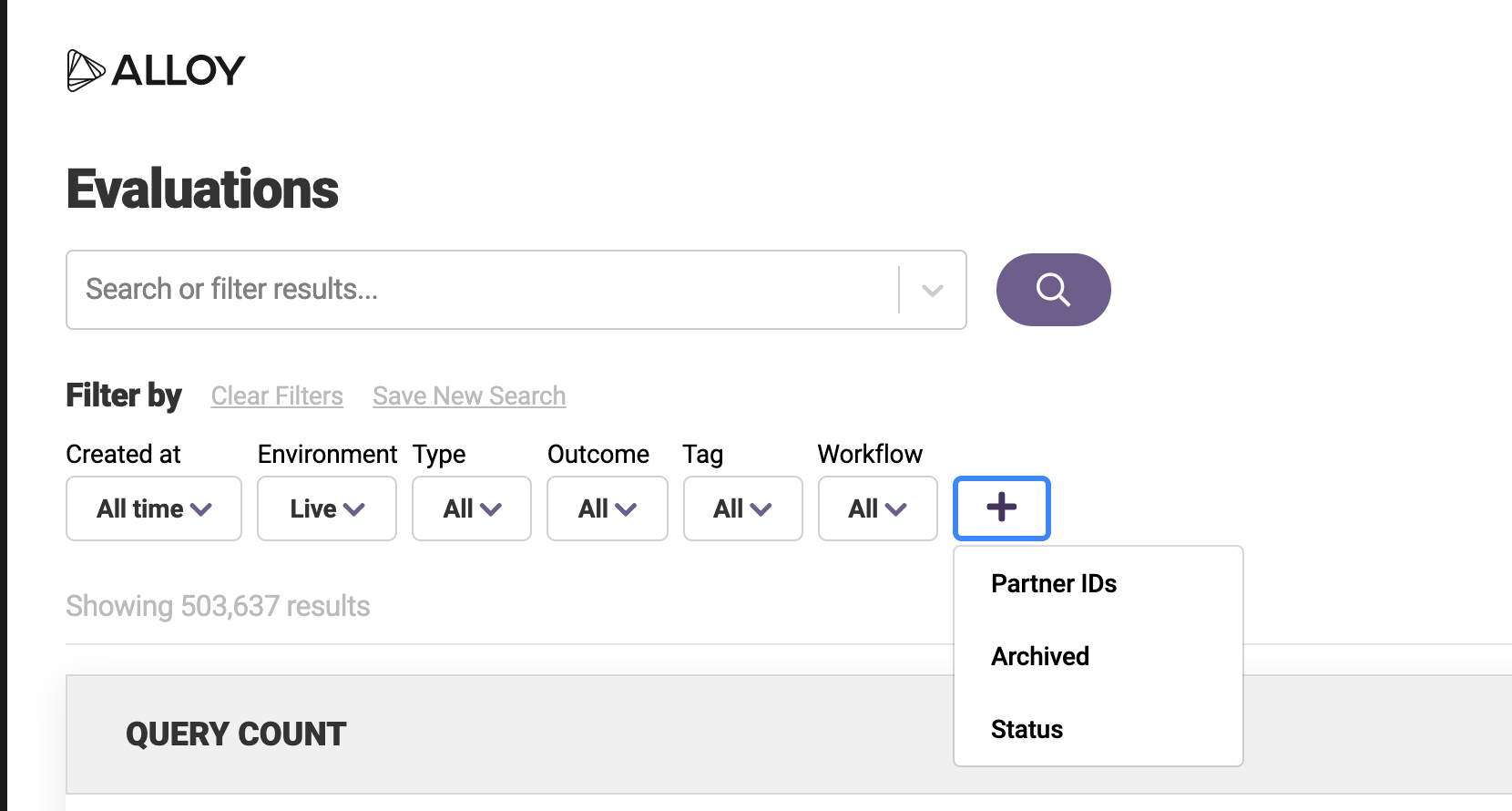
First, navigate to your review queue and click on the + icon in the Filter by section.

Filter 1
Filter 2

Select Last reviewed by the menu and select the reviewer to filter on.

Filter 3
Filter 4

Another way to do this is by using the search bar, in the dropdown menu or through a search term.

Filter 6

Entities can now be viewed with external entity ID

Prior this this update, Entities could be accessed with the Alloy Entity Token via /entities/< Alloy-Entity-Token >. Now entities can also be accessed with an organization's own entity ID via /entities/<

Use FEIN number to trigger sandbox value

Users can now use a Federal Employer Identification Number (FEIN) to trigger a sandbox value when executing a business evaluation in sandbox. To enable, go to Settings> Sandbox

New webhooks now available for Evaluation actions

New Webhooks Available for Evaluation Actions

In Alloy, a Webhook is a tool that allows the Alloy platform to create an outgoing request when something happens. Webhooks will alert external services when certain actions occur.

We have added two new webhooks that will be triggered when "Manually Run Evaluation" or "Manually Rerun Evaluation" is used in the dashboard.

Setup

Settings > Webhooks > + Webhook > What action should trigger this webhook?

Select "Notify on Creating an Evaluation Manually" and/or "Notify on Rerunning an Evaluation Manually"

For more information on Webhook setup, please visit our support page.

Webhooks Setup

Webhook Setup Image

Create Webhook

Create Webhook

Manually Run Evaluation Response Code

Manually Run Evaluation Response Code

Manually Rerun Evaluation Response Code

Manually Rerun Evaluation Response Code


Set permissions to determine which users can see Social Security Number within Alloy

Permissions are now available to determine which users can see Social Security Numbers (SSN) within Alloy. Admins can restrict access to SSN for a given user role or specific agent.

There are three levels of access which can be configured within settings:

  • View full SNN (123-45-6789)
  • View last four digits of SSN (xxx-xx-6789)
  • Mask full SSN (xxx-xx-xxxx)

Configure Permissions

By default, all users have full SSN permission. Clients who wish to restrict access will need to update their user role and agent permissions accordingly.

Restricted Views

Please be aware that users with partial SNN or masked SSN permissions will have limited access to certain functionalities. For example, they will not have access to Evaluation Raw Response data.

Back