Fraud Attack Radar: Detect emerging fraud patterns with Alloy's Actionable AI solution
Jun 26, 2026
Actionable AI fraud detection tool helps Alloy's clients stop fraud attacks before they escalate
Editor's note: This article was originally published on March 10, 2025, to announce Fraud Attack Radar. It has been updated to reflect the latest features, capabilities, and product information.
In this article, we're going to discuss:
- What is Alloy's Fraud Attack Radar?
- What makes Fraud Attack Radar different from other AI-powered fraud prevention tools?
- Key benefits of Fraud Attack Radar
- Real results: Fraud Attack Radar in action
Introducing Fraud Attack Radar
Artificial intelligence (AI) is evolving rapidly, stirring excitement and concern around how fraudsters are leveraging it to streamline attacks against financial institutions and fintechs.
So, let’s get straight to the point: this isn’t just another fraud prevention tool making vague promises or doing the minimum. While monitoring for suspicious activity is a critical function, plenty of AI-powered fraud tools produce alerts when red flags emerge.
In other words, it isn’t new. It also isn’t the best way to cultivate operational efficiency. (Think of it like a home security system that only sounds an alarm when a burglar breaks in but doesn’t call the police.) An alert helps, but real protection requires action.
That’s why Alloy built a groundbreaking solution that proactively alerts financial organizations to incoming fraud attacks and provides immediate next steps: Fraud Attack Radar. This AI-driven fraud detection system uses intelligent automation to offer insights into why an attack is happening, who’s behind it, and, most importantly, how to respond effectively in high-risk scenarios.
The core philosophy behind Fraud Attack Radar is to provide financial institutions and fintechs with Actionable AI. This risk management tool sits within Alloy’s platform, so our clients can immediately update their workflows to contain the threat.
What is Alloy’s Fraud Attack Radar?
Fraud Attack Radar solves the hardest problem in financial fraud prevention: precisely detecting and stopping both known fraud schemes and emerging fraud patterns that neither you nor your fraud vendors have seen before. This includes attacks tied to synthetic identities, where fraudsters use blended or stolen personally identifiable information (PII) to target onboarding workflows at scale.
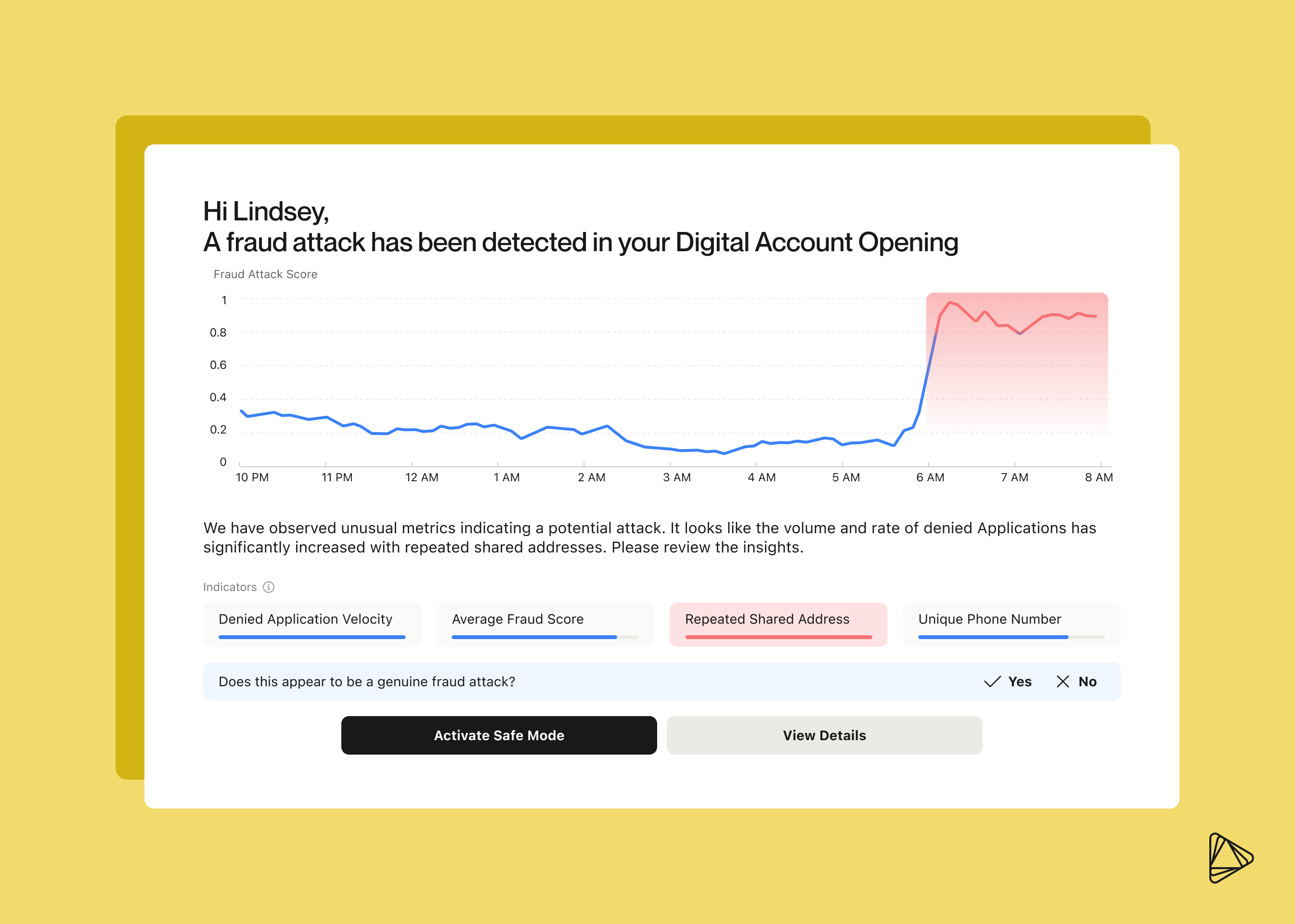
When a large-scale fraud attack is suspected in your origination funnel, Alloy proactively sends you an alert and enables you to take immediate action within the platform to triage, investigate, and optimize your workflows.
If we continue the home security system analogy, Fraud Attack Radar alerts you of the break-in, then it secures the burglar’s entry point and sends help.
What makes Fraud Attack Radar different from other AI-powered fraud prevention tools?
Fraud Attack Radar was built to solve a specific problem: detecting and containing coordinated fraud attacks at scale. Here’s how it does that, and why traditional fraud tools fall short.
Actionable AI fraud prevention
While most AI solutions on the market can alert you when they detect fraud, they can’t help you take immediate action to stop the attack.
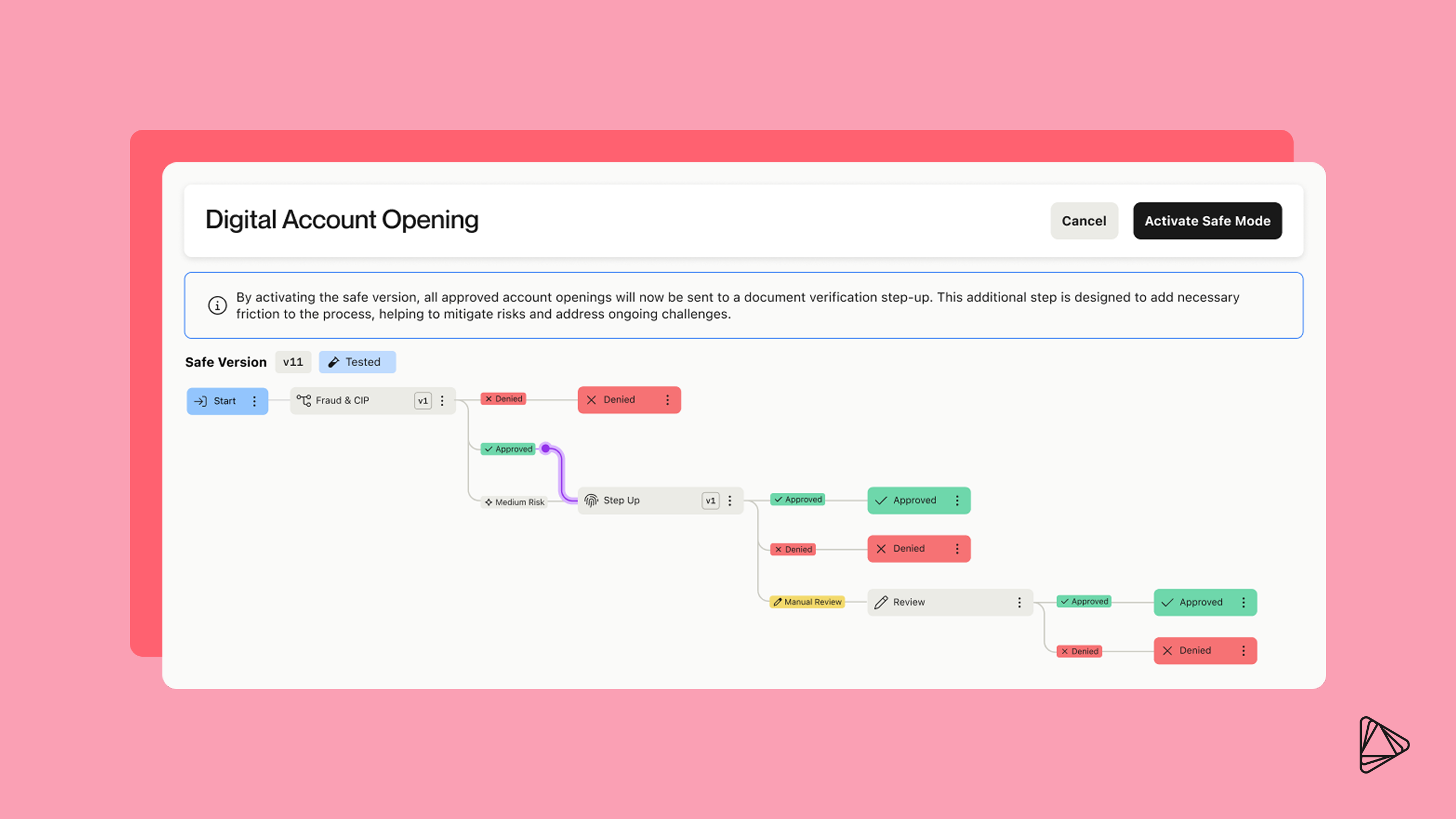
Alloy can. Once Fraud Attack Radar tells you that you may be dealing with a large-scale fraud attack, it enables you to turn on pre-approved fallback (or “safe mode”) policies to quickly contain the threat — like introducing step-up verification and multi-factor authentication (MFA). These measures let you keep your onboarding funnel open, which keeps good customers coming in. In other words, you can contain risk without compromising customer experience.
Because Fraud Attack Radar’s risk scoring model sits within Alloy’s end-to-end identity and fraud prevention platform, our clients can seamlessly close the loop between real-time detection and action. That means activating fallback workflows to contain the immediate threat, digging into triage and investigation tools to understand its scope, and iterating policies long-term.
Industry-wide onboarding intelligence
AI models are only as good as the datasets they are built off of. At Alloy, we have spent the last decade working to prevent, detect, and mitigate fraud. During that time, we’ve developed unique insights into the fraud attack strategies that scammers use to target consumers and the financial services industry at large.
For example, fraudsters rely on familiar playbooks, often starting with scams that trick customers into sharing personal information. These escalate into known third-party fraud schemes, like account takeovers, payment fraud, new account fraud, and credit card fraud.
Even entirely new fraud tactics create detectable patterns across your applicant population when deployed at scale, across institutions. We use network insights to inform the Fraud Attack Radar so it can accurately identify organized fraud attack patterns and adapt as AI technology evolves.
Supervised and unsupervised machine learning models
Alloy’s Fraud Attack Radar combines both anomaly detection and time series methods approaches, using AI and machine learning (ML) to detect and stop fraud proactively without excessive noise from high false positive rates. This helps you distill financial crime signals from white noise.
For example, other AI system providers may needlessly alert you when there is an influx of credit card applicants due to a marketing campaign, which looks the same to raw UML anomaly detection algorithms. Because Fraud Attack Radar is able to accurately detect the characteristics that make a fraud attack unique, your operational teams won’t waste time investigating customer behavior that isn’t truly risky. It’s a digital transformation investment that keeps your fraud operations focused and effective.
Portfolio-level analysis
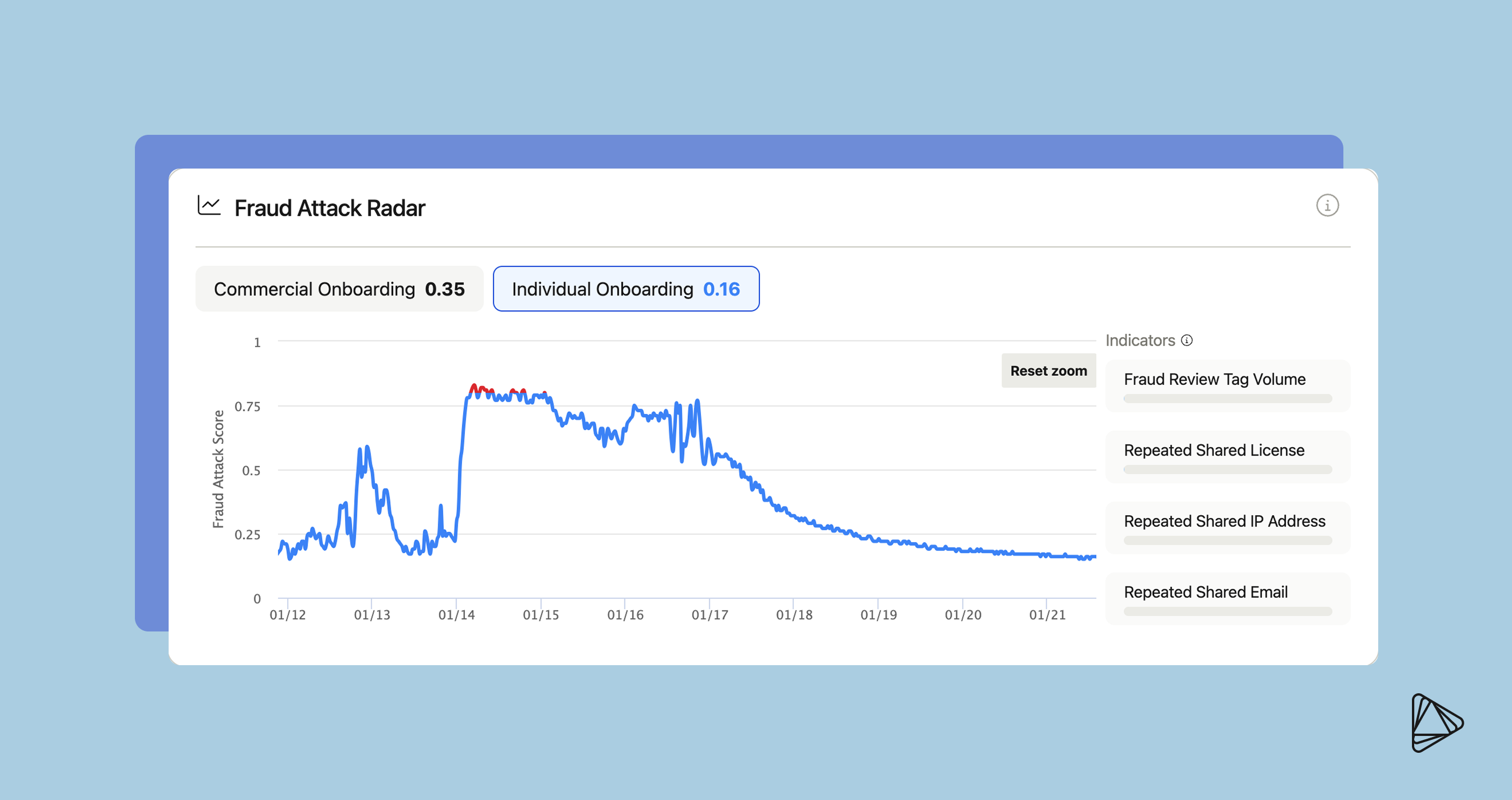
Fraud Attack Radar is designed to work at the portfolio level, looking for trends across an entire population of applications instead of trying to predict whether a specific individual or applicant looks fraudulent. This approach helps you detect a sudden increase in pressure or clusters of novel behavior.
When Fraud Attack Radar is combined with Alloy’s Fraud Signal — our predictive ML model built for individual-level risk scoring — you get a complete view of risk across your portfolio and individual accounts. Fraud Signal connects onboarding data with transaction monitoring, behavioral analytics, and third-party data sources to deliver dynamic risk assessments that update whenever potential fraud is identified. Full-lifecycle fraud detection gets rid of the silos that fraudsters use to circumvent traditional fraud detection by unifying identity signals in a visual dashboard. Teams can adjust risk thresholds as needed as well as which data points are prioritized, without overhauling their workflows.
Check out Alloy's full suite of Actionable AI solutions here
Key benefits of Fraud Attack Radar
- Detect and mitigate fraud faster: Get real-time notifications and take prompt action.
- Reduce financial losses: Contain attacks before they escalate.
- Minimize disruption: Keep the origination funnel open while addressing threats.
- Deploy effortlessly: No complex configurations and no long setup process. With Fraud Attack Radar, benefits compound quickly and across use cases.
- Receive accurate alerts: Maintain a low false positive rate.
- Triage, clean-up, and remediate with ease: Alloy lists entities identified as contributing to a fraud attack and offers targeted recommendations to help with manual review cleanup.
Real results: Fraud Attack Radar in action
Fraud Attack Radar has been battle-tested in real-world scenarios, delivering proactive fraud detection when it matters most.
Here’s what our clients have seen to date:
- Detecting a wide range of attacks – From applicants using shared IP addresses and caps-locked applications to high-volume email domains and auto-generated content, our model has flagged suspicious activity across multiple fronts.
- Catching fraud before it escalates – Fraudsters don’t strike all at once; they test vulnerabilities first. Our tool successfully identifies early-stage fraudulent activity — stopping small-scale probing before it turns into a full-scale attack.
- Stopping fraud rings in their tracks – Fraud Attack Radar detected a coordinated fraud ring in Massachusetts, where dozens of applications originated from the same IP address. The financial institutions under attack were able to take immediate action.
Stay on top of suspicious activity with Fraud Attack Radar
Fraud isn’t going away. But with the right technology, financial institutions and fintechs can stay ahead of fraudsters. Fraud Attack Radar gives you the power to detect and stop fraud attacks before they cause significant damage.
Want to get a closer look at Fraud Attack Radar?

Parilee Edison Wang is the Chief Operating Officer and Chief Product Officer at Alloy. She has spent the last 15 years working in product and fintech, driven by the opportunity to help solve interesting problems without obvious answers. Prior to Alloy, Parilee led Product at Bread and was a part of the product team at OnDeck. Parilee received her bachelor's degree in international relations from Stanford University in 2008 and a master’s in business administration from Harvard Business School in 2013.