
Know Your Customer (KYC)
Perpetual KYC software for financial institutions and fintechs
Verify identity in seconds and continuously monitor risk as it evolves. Agentic research and analysis give you clear visibility into risk levels and the factors behind each evaluation.
OUR APPROACH
Continuous KYC for customers who don't stand still
Traditional KYC treats identity verification as a one-time event at customer onboarding, followed by a fixed periodic review. But customer behavior changes, new sanctions or PEP designations emerge, and adverse media can surface at any time.
Alloy's perpetual KYC continuously validates customer identity and risk signals, connecting KYC to your broader identity risk strategy, so compliance teams maintain an accurate, real-time view of risk without waiting for the next scheduled review.
The result: financial institutions can verify more legitimate customers faster while reducing compliance risk and manual overhead.
Capabilities
Streamlined KYC checks
Flexible decisioning
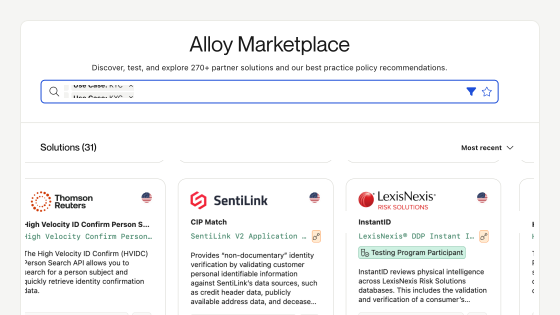
Bring together your preferred KYC providers
Orchestrate 300+ data solutions (including identity, document, device, fraud, and watchlist checks) and create customized workflows based on product lines, geography, and risk tolerance.
Monitor customer risk
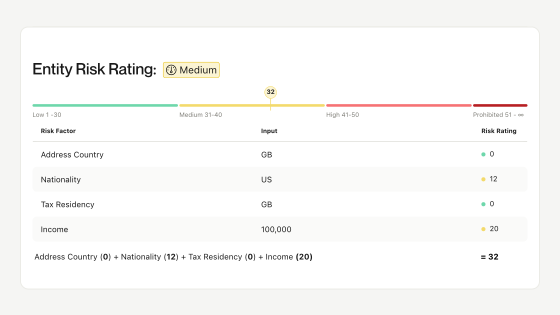
Build a holistic, evolving risk assessment over the customer lifecycle
Extend KYC beyond account opening with perpetual monitoring and dynamic risk profiles that evolve as customer behavior changes.
Offer friction-right experiences
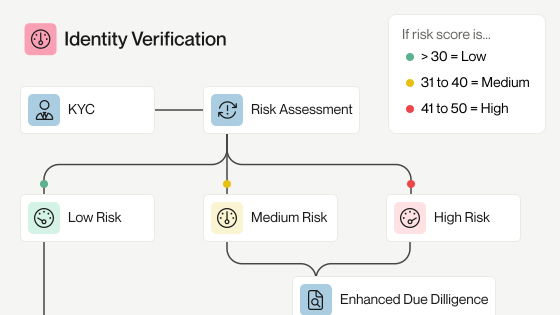
Reduce friction without compromising risk controls
Alloy brings identity verification and authentication together within a broader decisioning framework. This allows risk management teams to apply the right level of scrutiny at each moment, reducing unnecessary friction for low-risk customers while running enhanced due diligence on high-risk customers.
Ensure compliance
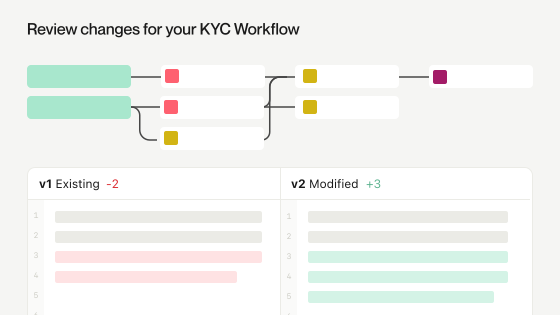
Leverage audit and expansion-ready KYC workflows
Meet KYC compliance and anti-money laundering requirements with explainable workflows that stand up to audits and remain defensible over time.
Bring together your preferred KYC providers
Orchestrate 300+ data solutions (including identity, document, device, fraud, and watchlist checks) and create customized workflows based on product lines, geography, and risk tolerance.
Build a holistic, evolving risk assessment over the customer lifecycle
Extend KYC beyond account opening with perpetual monitoring and dynamic risk profiles that evolve as customer behavior changes.
Reduce friction without compromising risk controls
Alloy brings identity verification and authentication together within a broader decisioning framework. This allows risk management teams to apply the right level of scrutiny at each moment, reducing unnecessary friction for low-risk customers while running enhanced due diligence on high-risk customers.
Leverage audit and expansion-ready KYC workflows
Meet KYC compliance and anti-money laundering requirements with explainable workflows that stand up to audits and remain defensible over time.
ACTIONABLE AI
A governable AI agent for your operationally heavy KYC tasks
Alloy's AI Assistant handles the manual legwork behind a KYC decision, so your team can focus on the decisions that require human judgement.
- Summarize why a case was flagged and recommend next steps
- Screen sanctions and watchlist hits, and recommend true/false matches
- Investigate identity discrepancies through open-web and social media research
- Review uploaded documents (like proof of address) against records
- Run enhanced due diligence (EDD) when risk warrants it
RICH, NATIVE CONTEXT
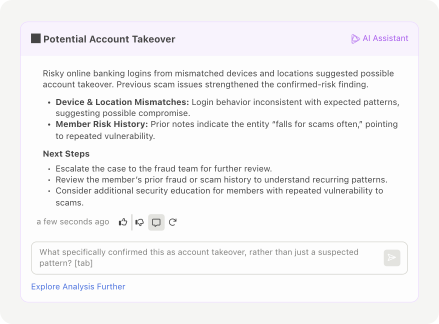
Trustworthy outcomes grounded in truth
The AI Assistant provides insights based on each customer's full identity verification history within Alloy and your organization's criteria for risk thresholds. Its recommendations reflect how your team has treated similar cases, ensuring standardization and consistency.
AUDIT-READY EXPLAINABILITY
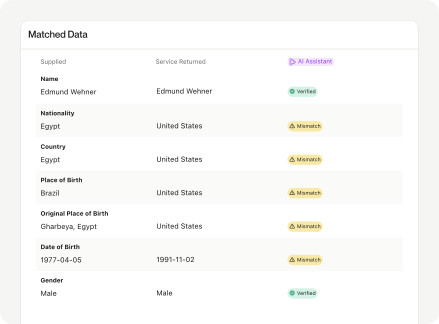
Every recommendation shows its work
If the AI Assistant flags a discrepancy — for example, a mismatch between a submitted ID and a credit bureau record — it shows exactly which fields didn't match and where each data point came from. That level of detail enables reviewers and regulators to follow the decision-making process.
CONFIGURABLE HUMAN-IN-THE-LOOP
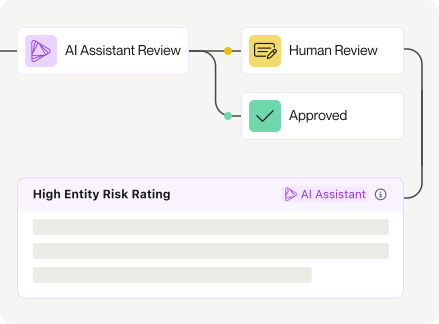
Automation on your terms
Start by setting the AI Assistant to draft recommendations for every case. Then, hand off full decisioning for segments you're confident in, like low-risk consumer onboarding, while keeping high-risk profiles or EDD cases routed to a human reviewer. You control where that line sits, and you can move it as your confidence in the automation grows.
TRUSTED SOURCE VERIFICATION
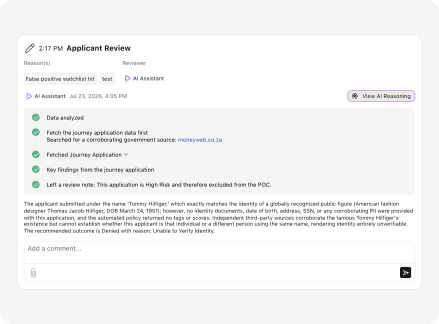
Every claim traced to its source
The AI Assistant follows a source hierarchy, starting with government ID databases, credit bureaus, and verified KYC vendors. It then layers in open-web research as supporting evidence, cross-checking names, addresses, and document details, and flagging what doesn't line up. It always links back to source URLs for verifiability.
Trustworthy outcomes grounded in truth
The AI Assistant provides insights based on each customer's full identity verification history within Alloy and your organization's criteria for risk thresholds. Its recommendations reflect how your team has treated similar cases, ensuring standardization and consistency.
Every recommendation shows its work
If the AI Assistant flags a discrepancy — for example, a mismatch between a submitted ID and a credit bureau record — it shows exactly which fields didn't match and where each data point came from. That level of detail enables reviewers and regulators to follow the decision-making process.
Automation on your terms
Start by setting the AI Assistant to draft recommendations for every case. Then, hand off full decisioning for segments you're confident in, like low-risk consumer onboarding, while keeping high-risk profiles or EDD cases routed to a human reviewer. You control where that line sits, and you can move it as your confidence in the automation grows.
Every claim traced to its source
The AI Assistant follows a source hierarchy, starting with government ID databases, credit bureaus, and verified KYC vendors. It then layers in open-web research as supporting evidence, cross-checking names, addresses, and document details, and flagging what doesn't line up. It always links back to source URLs for verifiability.
END-TO-END COMPLIANCE
One platform for your entire compliance program
Alloy's perpetual KYC runs on Alloy's identity and fraud intelligence platform, which also powers AML monitoring, case management, and regulatory filing, so every workflow works from one connected, real-time view of risk.
- AML monitoring and watchlist screening
- Case management and investigations
- SAR/CTR filing
- KYB + KYC

Resources
Go deeper


FAQs
-
What is a KYC API?
A KYC API lets you build identity verification directly into your own onboarding flow, instead of relying on a separate portal or manual process. Alloy's KYC API connects to a wide network of identity verification, credit bureau, and biometric data partners through a single integration, so you can run identity checks, sanctions and PEP screening, and risk-based decisioning in real time, all from one API call. This gives engineering teams a single point of integration while compliance teams retain full audit trail visibility into every decision the API makes.
-
What features should I look for in KYC software?
Look for software that covers identity verification across the full customer lifecycle, not just at account opening. Strong KYC software should support core customer due diligence (CDD) workflows out of the box, including sanctions list and PEP screening, adverse media checks, and biometric verification, plus ongoing monitoring that flags risk changes after onboarding. It's also worth evaluating case management and audit trail depth and how many data sources and credit bureaus the platform connects to.
-
How does perpetual KYC (pKYC) differ from traditional KYC?
Perpetual KYC is the continuous, real-time verification of customer identity and risk. Traditional KYC treats identity verification as a one-time event at customer onboarding, followed by a fixed annual review. But customer behavior changes, new sanctions or PEP designations emerge, and adverse media can surface at any time. Alloy's perpetual KYC continuously validates customer identity and risk signals, connecting KYC to your broader fraud prevention strategy, so compliance teams maintain an accurate, real-time view of risk without waiting for the next scheduled review.
-
Can the same software be used for KYC and know your business (KYB)?
Often, yes. Many platforms, including Alloy, support KYC and business verification within the same orchestration engine, since the underlying building blocks overlap significantly. KYC and KYB solutions both provide identity verification, sanctions and PEP screening, case management, and an audit trail. The difference is what's being verified: KYC focuses on individual identity, while KYB extends that to business entities, ownership structures, and the people who control them.
-
Does KYC software support biometric identity verification?
Yes, biometrics are increasingly standard in KYC workflows, particularly for remote onboarding where a physical document check isn't possible. KYC software can incorporate facial recognition, liveness detection, and document verification alongside traditional identity verification checks, and route lower-confidence matches to manual review. Alloy orchestrates biometric verification through its partner network alongside other identity signals, so it's evaluated as one input in a broader risk decision rather than a standalone pass/fail check.
-
How does KYC software support AML screening and regulatory compliance?
KYC software builds core anti-money laundering (AML) requirements directly into onboarding and monitoring workflows: automated sanctions screening and politically exposed persons (PEP) screening, adverse media checks, and an audit trail that documents exactly how and why each decision was made. Because regulatory requirements vary by geography and evolve over time, strong KYC platforms let compliance teams adjust thresholds and controls without re-engineering the underlying workflow, reducing false positives and keeping programs current without a rebuild every time a rule changes.
-
Does KYC software support ongoing transaction monitoring?
Many KYC platforms extend into transaction monitoring so identity risk and behavioral risk are evaluated together rather than in separate systems. Alloy, for example, lets teams trigger re-verification or escalate a case based on transaction patterns, not just static identity data, so a customer's risk profile reflects what they're actually doing on the platform, not just who they were determined to be at onboarding.
-
Does KYC software support enhanced due diligence (EDD)?
Yes, strong KYC platforms apply enhanced due diligence dynamically based on risk score, rather than as a manual process layered on after the fact. When a customer triggers elevated risk, the system can automatically route the case for deeper review and additional verification. This risk-based approach means EDD resources go toward the customers who actually warrant it, while standard due diligence keeps moving quickly for everyone else.
-
What are some of the leading KYC software providers?
The KYC space includes both broad identity-verification platforms and specialists in AML and sanctions screening. But choosing a single point solution often means stitching together multiple vendors as your program grows. Alloy takes a different approach. Our orchestration platform lets you access and combine the industry's best KYC data and technology through a single integration, so you can choose the right vendor for each use case without building separate connections. Leading options in Alloy's partner network include:
- LexisNexis, SentiLink, and Socure which support US KYC and CIP through identity verification, with options for fraud scoring and field level matching including sanctions, PEP, and adverse media screening.
- Trulioo, GBG, and LSEG which support global KYC by matching personal information against local and international data sources across countries.
Because all six are orchestrated through Alloy's platform alongside credit bureau data, biometrics, and other risk signals, you get the right data source for every use case — and the flexibility to add, swap, or combine vendors as your risk needs evolve — without managing separate integrations or vendor relationships.