
Article
Alloy’s agentic harness provides the foundation to put AI to work safely across your risk operations.
"Alloy's AI agent saves me a significant amount of time and gives me the confidence to quickly review and close watchlist alerts based on the insights it provides."
—Edward Campiani, Chief Compliance Officer, EDGE
Automation of pended applications at a top 5 credit union
Automation of watchlist alert clearing — with zero errors — at a large capital markets firm
Faster AML investigation reviews at a $3B+ asset credit union
Bring the context, signals, and reasoning reviewers need into one place, drawn from Alloy's decisioning engine and each customer’s full lifecycle data.
Handle more cases without adding tools or headcount. Our AI agents act within your Alloy workflows and carry work through the final case update.
Alloy’s agentic harness grounds outputs and actions in your policies and authorized data, with traceable reasoning and flexible human oversight.
Alloy’s AI agents use your policies and case context to investigate, recommend, and resolve or escalate cases inside the same decisioning engine that powers your automation today. Agents combine skills like document review and open web research to work through a case how a human analyst would.
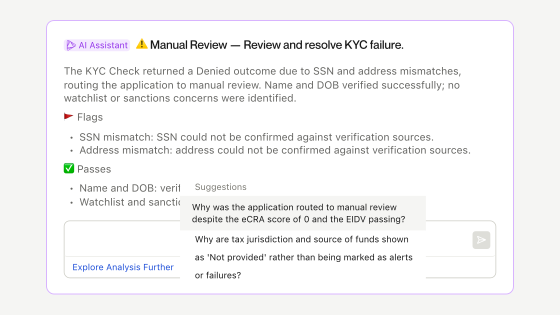
When a workflow or risk threshold triggers review, our platform-wide AI Assistant explains what happened, why a case needs attention, and what signals to look at. Analysts can ask questions via chat and focus on the review instead of switching between screens to piece facts together.
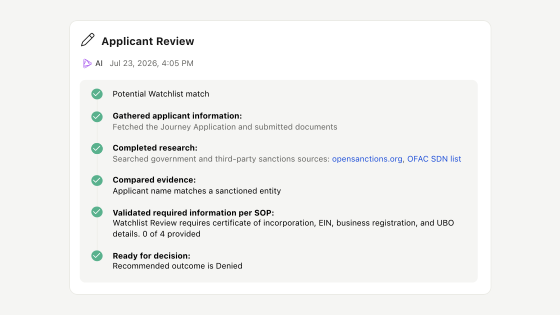
Our AI agents can gather information, complete research, and compare evidence. Your standard operating procedure (SOP) defines the steps and evidence each workflow requires, and the AI agent validates the required information before a case moves to a decision.
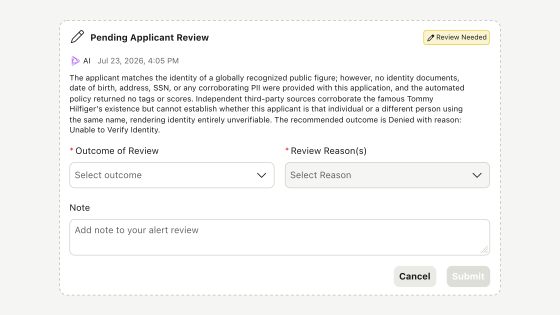
Based on your configuration, the AI agent can recommend or autonomously execute, but it’ll always document the outcome and update the case. When human judgment is needed, the agent routes the case to a reviewer.
When a workflow or risk threshold triggers review, our platform-wide AI Assistant explains what happened, why a case needs attention, and what signals to look at. Analysts can ask questions via chat and focus on the review instead of switching between screens to piece facts together.
Our AI agents can gather information, complete research, and compare evidence. Your standard operating procedure (SOP) defines the steps and evidence each workflow requires, and the AI agent validates the required information before a case moves to a decision.
Based on your configuration, the AI agent can recommend or autonomously execute, but it’ll always document the outcome and update the case. When human judgment is needed, the agent routes the case to a reviewer.
Equipped with specialized skills and guided by your policies, Alloy’s AI agents carry work from investigation to resolution inside familiar workflows within the Alloy platform.
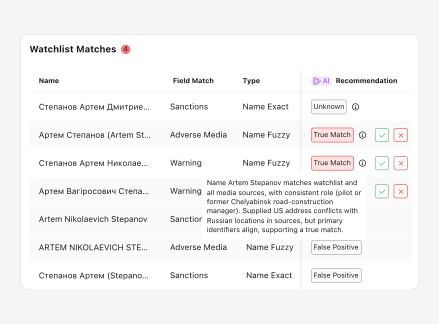
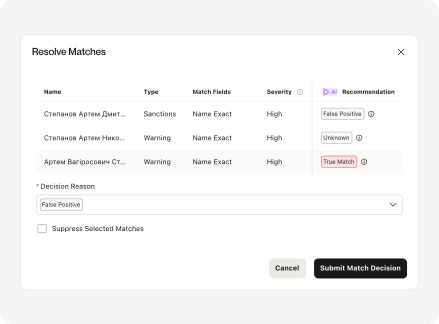
Spend less time researching watchlist hits. Alloy’s Watchlist Screening Agent examines matches and researches adverse media and government sources to recommend whether a match is a true or false positive, providing full supporting rationale to accept or override.
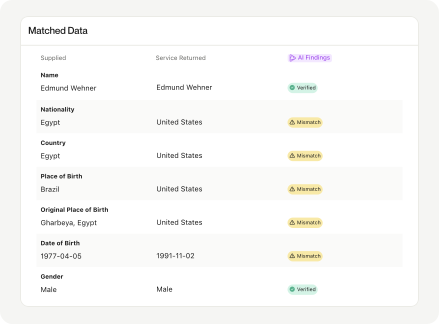
Validate applicant and customer data against authoritative sources, investigate watchlist hits through your configured providers, and check uploaded documents for tampering, expiry, or mismatches.
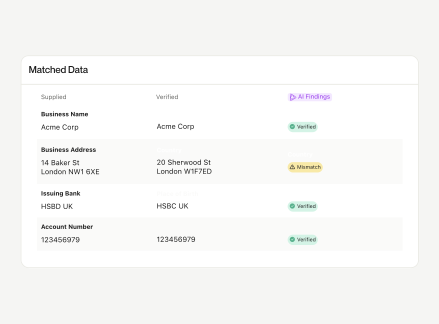
The KYB Agent verifies business details and documents, validates beneficial owners and ownership thresholds, screens the business and key principals for watchlist hits, and flags any complex or layered ownership structures that warrant closer review.
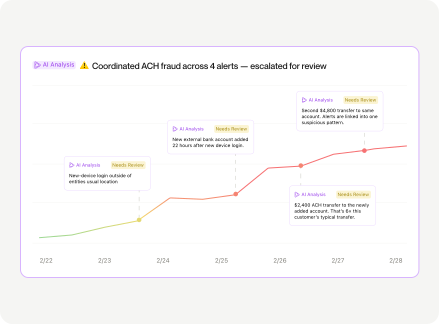
Follow defined procedures, connect evidence, and produce consistent findings and case documentation. The Fraud Investigation Agent identifies trends across alerts and explains anomalies clearly. Then it flags an alert as suspicious, dismisses it, or escalates it.
The AML Investigation Agent works through your required checks and documents findings as it goes, reducing time spent assembling evidence and writing case notes. Each case follows your defined process, with ambiguous or suspicious findings escalated to analysts alongside the context they need.
Spend less time researching watchlist hits. Alloy’s Watchlist Screening Agent examines matches and researches adverse media and government sources to recommend whether a match is a true or false positive, providing full supporting rationale to accept or override.
Validate applicant and customer data against authoritative sources, investigate watchlist hits through your configured providers, and check uploaded documents for tampering, expiry, or mismatches.
The KYB Agent verifies business details and documents, validates beneficial owners and ownership thresholds, screens the business and key principals for watchlist hits, and flags any complex or layered ownership structures that warrant closer review.
Follow defined procedures, connect evidence, and produce consistent findings and case documentation. The Fraud Investigation Agent identifies trends across alerts and explains anomalies clearly. Then it flags an alert as suspicious, dismisses it, or escalates it.
The AML Investigation Agent works through your required checks and documents findings as it goes, reducing time spent assembling evidence and writing case notes. Each case follows your defined process, with ambiguous or suspicious findings escalated to analysts alongside the context they need.
Delegate work while keeping control of how it gets done. Set AI agent responsibilities and boundaries and expand its role as your teams gain confidence.
Configure the steps, evidence, escalation criteria, and output structure required for each workflow.
You dictate when to keep a reviewer in the loop, when to require approval for sensitive actions, and when a decision can be fully automated.
Apply familiar roles, permissions, and audit infrastructure without introducing a separate operating environment.
Automatically capture the information reviewed, steps completed, reasoning applied, and resulting action to stay audit-ready.
Putting an AI agent to work takes more than a prompt. Alloy has the agentic harness and supporting infrastructure to test, deploy, monitor, and manage agents with confidence. Paired with our deep decisioning context, we’ll set you up with an AI operating model for the next decade of risk operations.
Article


Alloy AI agents automate research, manual reviews, and case resolution across risk and compliance workflows. Embedded in Alloy’s orchestration system of record, they use your data, policies, and operating procedures to gather evidence, assess findings, and take permitted actions. Our KYB, KYC, Fraud and AML Investigation Agents can review watchlist matches, examine documents, research businesses, and investigate potential fraud or money laundering. Depending on how the agents are configured, they can resolve cases or escalate them for human review, reducing repetitive work and helping your team focus on cases that need human judgment.
Our AI agents are powered by Alloy’s agentic harness: the infrastructure to configure, test, deploy, monitor, and manage agents. It connects them to the context and tools needed to act within your workflows, with controls over what they can do, when people step in, and how their work is documented.
An embedded AI agent runs inside the decisioning platform itself, with direct access to the rules, history, and data behind each case, while a standalone agent works from whatever information is passed to it. Alloy's AI agents are embedded, so it can explain why a case is in review and record its actions in the same case, with no results to move between systems.
For KYB/KYC tasks, our agents can take on the research and review steps that slow the work down, including application review, document review, open web research, UBO corroboration, and screening for sanctions, politically exposed person (PEP), and adverse media hits. For business onboarding, it confirms who a company is, where it's registered, and who owns it, and sends anything unclear to a reviewer.
No, Alloy AI agents enhance human work without replacing it. They handle the repeatable, high-volume steps of a review so analysts can spend their time on judgment calls, customer decisions, and the cases that need a closer look. Your team decides where a reviewer stays involved, which actions need approval, and which clear outcomes the agent can resolve on its own.
AI agent actions are audited through thorough records. Every action an agent takes is logged in Alloy, including the information it reviewed, the steps it completed, the reasoning it applied, and the outcome. The log sits in the same case as the decision, so reviewers and examiners can trace any action back to its reasoning without pulling records from another system.