
TRANSACTION MONITORING
See the customer behind every transaction
Alloy connects the dots between transactions, onboarding
data, behavioral patterns, and account activity to help you
surface suspicious transactions in real time.
"Alloy helps us feel more confident about who's making the request, so we can move ahead on higher-risk features without inviting more fraud."
Diana Nixon Vice President of Digital Strategy at Suncoast Credit Union
-
35%
Decrease in fraud rates
-
22M
Monthly logins
-
98%
Auto-decisioning on logins
ACTIONABLE AI
Actionable AI: intelligence across Alloy's network
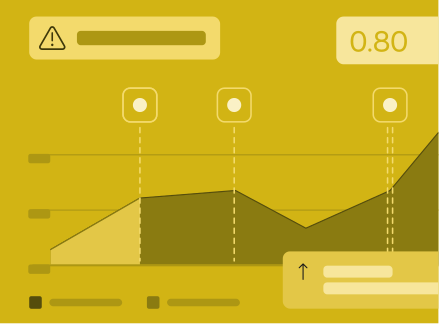
Alloy’s machine learning model, Fraud Signal, takes an identity-centric approach to risk monitoring, assigning each customer a fraud risk score that evolves over time. Fraud Signal is continuously trained on aggregated patterns of fraud behavior to keep you in lockstep with emerging threats.
AML TRANSACTION MONITORING
Stay ahead of AML and terrorist financing
Deploy AML rules on day one,
customize as you grow
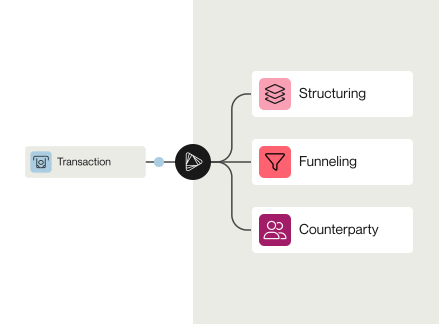
Out-of-the-box transaction monitoring rules cover the most common anti-money laundering (AML) typologies from day one — like structuring, funneling, rapid money movement, and high-risk counterparties. Custom rules can be layered on and modified through a no-code interface, enabling configuration without engineering support.
Fewer false positives, more time
on what matters
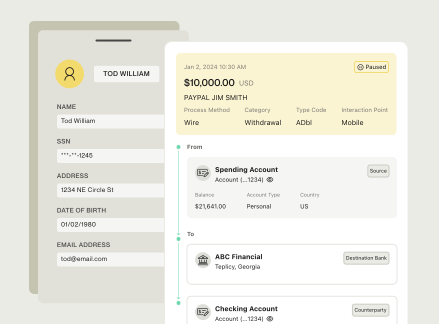
Alloy evaluates every transaction against the customer's full identity and activity profile, including know your customer (KYC) data, onboarding history, and customer due diligence checks. Richer context means alerts are more precise, more actionable, and less likely to pull analyst attention toward activity that doesn't warrant it.
Sanctions coverage that goes beyond
the account holder
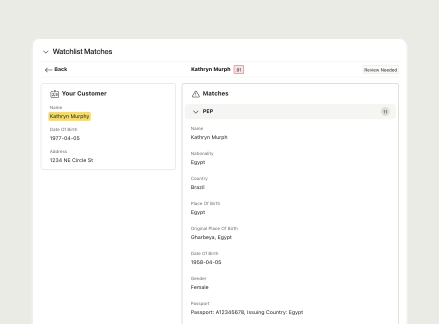
Get access to the most up-to-date watchlists, stay on top of your regulatory obligations, and ensure you’re doing business with compliant customers. Alloy allows you to set up recurring automated checks against 1000+ sanctions, PEP, and adverse media sources, then alerts you in real time if there are any matches.
FRAUD MONITORING
Catch fraud after onboarding
Transaction fraud
Individual account opening
Without Alloy
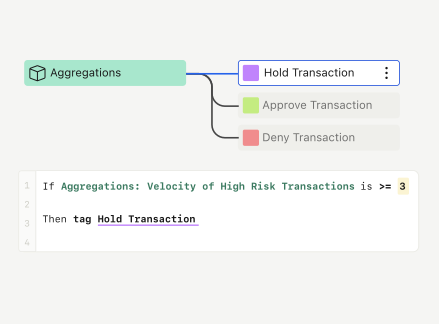
An account that cleared onboarding cleanly starts moving unusual volumes of funds across counterparties. Without monitoring rules tuned to that pattern, the activity looks like normal behavior until the losses pile up.
With Alloy
Monitoring rules flag high-velocity deposits, rapid outflows, and unusual counterparty volume in real time. When the risk warrants it, automated interdiction can hold transactions before funds leave your institution.
Account takeover fraud
Stop high-risk account changes
Without Alloy
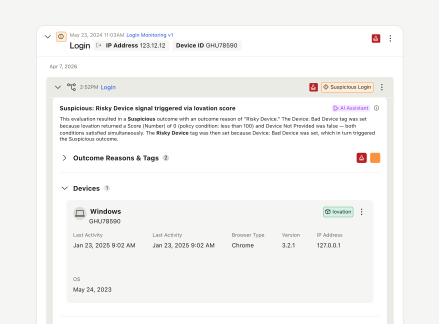
A fraudster gains access to a legitimate customer's account, then makes subtle changes — a new phone number, a new device, a change of address — through a low-friction channel.
With Alloy
Account activity monitoring flags high-risk events such as changes to contact details, new authorized signers, and anomalous device or login behavior. Configurable workflows automatically trigger step-up verification, so customers with legitimate account changes can flow through easily.
Bust-out fraud
Catch red flags in existing customer relationships
Without Alloy
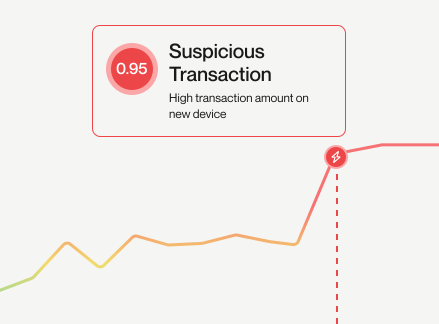
A customer gradually exhibits suspicious patterns over time — increasing credit utilization, unusual transactions, a sudden change in behavior — that don't trigger alerts because they are evaluated individually, not collectively.
With Alloy
Continuous risk scoring tracks behavioral shifts over time, flagging anomalies that only become visible in aggregate. When transaction patterns deviate from a customer's established baseline, Alloy surfaces it for further investigation before losses occur.
Individual account opening
Without Alloy
An account that cleared onboarding cleanly starts moving unusual volumes of funds across counterparties. Without monitoring rules tuned to that pattern, the activity looks like normal behavior until the losses pile up.
With Alloy
Monitoring rules flag high-velocity deposits, rapid outflows, and unusual counterparty volume in real time. When the risk warrants it, automated interdiction can hold transactions before funds leave your institution.
Stop high-risk account changes
Without Alloy
A fraudster gains access to a legitimate customer's account, then makes subtle changes — a new phone number, a new device, a change of address — through a low-friction channel.
With Alloy
Account activity monitoring flags high-risk events such as changes to contact details, new authorized signers, and anomalous device or login behavior. Configurable workflows automatically trigger step-up verification, so customers with legitimate account changes can flow through easily.
Catch red flags in existing customer relationships
Without Alloy
A customer gradually exhibits suspicious patterns over time — increasing credit utilization, unusual transactions, a sudden change in behavior — that don't trigger alerts because they are evaluated individually, not collectively.
With Alloy
Continuous risk scoring tracks behavioral shifts over time, flagging anomalies that only become visible in aggregate. When transaction patterns deviate from a customer's established baseline, Alloy surfaces it for further investigation before losses occur.
COMPLETE COVERAGE
Monitor across every payment type
-
P2P
Alloy monitors P2P activity against behavioral baselines and detects deviations, such as unusual recipient patterns, first-time transfers to new payees, and velocity spikes that could indicate account compromise or authorized push payment fraud.
-
ACH
ACH transactions are a common vector for bust-out schemes and unauthorized debits. Alloy monitors ACH activity in real time, flagging high-volume deposit-and-withdrawal patterns, unusual counterparty behavior, and account changes that often precede ACH abuse.
-
Production-ready global solutions
Access over 270 top data sources through Alloy’s fully productized marketplace, backed by contracted partner agreements and integrations Alloy delivers and maintains on behalf of clients. As your business expands into new product lines or markets, activate global solutions without custom build or added technical lift.
-
RTP/FedNow
Real-time payments are instant and largely irrevocable. Alloy evaluates the identity and behavioral risk behind every RTP and FedNow transaction before it's authorized, so your team can interdict suspicious payments at the moment they matter most.
-
Stablecoin
Alloy monitors stablecoin activity for patterns associated with layering, rapid conversion, and high-risk counterparty exposure, helping you stay ahead of crypto scams.
-
Wire
Wire transfers are a frequent target for business email compromise, account takeover, and money laundering. Alloy weighs wire activity against customer risk profiles, and triggers step-up verification for high-risk transactions before funds leave your institution.
INVESTIGATION AND REPORTING
Go from alert to resolution in one place
AI Assistant
Accelerate investigations with agentic AI
Without Alloy
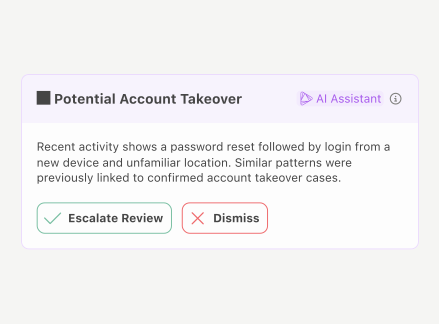
Gathering the data needed to make a confident decision creates time-intensive manual work before the actual investigation even starts.
With Alloy
Alloy's AI Assistant surfaces relevant findings automatically, summarizes account activity, and flags connections to prior cases so analysts can quickly move from alert to resolution.
SAR filing
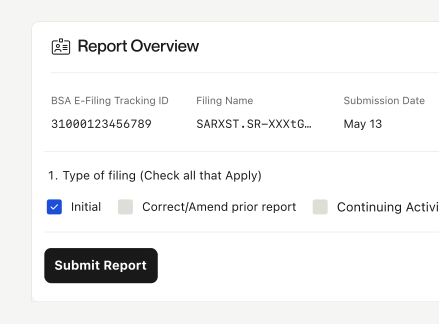
File with FinCEN without leaving your dashboard
Without Alloy
Aggregating data for suspicious activity reports (SARs) and currency transaction reports (CTRs) means pulling from multiple systems and reformatting it to meet FinCEN's requirements. The result is hours of administrative work that takes analysts away from actual investigations.
With Alloy
SARs and CTRs are directly eFiled with FinCEN from Alloy's case management system. Subject and transaction details pre-populate automatically, so analysts spend their time on critical casework — not paperwork.
Audit trails
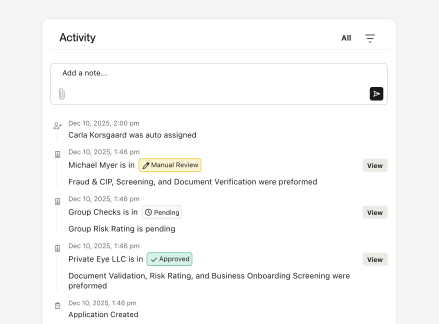
Get a complete audit trail for every case
Without Alloy
When investigations are spread across systems, audit trails are incomplete, and it's hard to demonstrate due diligence to regulators.
With Alloy
A single case management dashboard brings entity history, transaction context, timeline view, and alert details into one place. Alloy automatically routes cases to the right team, so investigations move quickly and nothing falls through
Analytics
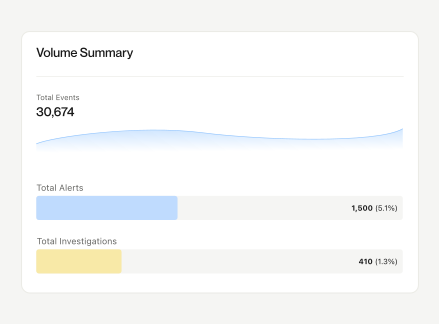
Access all your performance data in a single console
Without Alloy
Compliance leaders lack a clear view of how their monitoring program is performing: what the backlog looks like, where alerts are piling up, and whether their rules are tuned correctly.
With Alloy
Analytics dashboards surface queue volume, disposition rates, SAR filings per agent, and review session length in real time. Compliance leaders can manage team capacity and refine monitoring policies based on what the data actually shows.
Accelerate investigations with agentic AI
Without Alloy
Gathering the data needed to make a confident decision creates time-intensive manual work before the actual investigation even starts.
With Alloy
Alloy's AI Assistant surfaces relevant findings automatically, summarizes account activity, and flags connections to prior cases so analysts can quickly move from alert to resolution.
File with FinCEN without leaving your dashboard
Without Alloy
Aggregating data for suspicious activity reports (SARs) and currency transaction reports (CTRs) means pulling from multiple systems and reformatting it to meet FinCEN's requirements. The result is hours of administrative work that takes analysts away from actual investigations.
With Alloy
SARs and CTRs are directly eFiled with FinCEN from Alloy's case management system. Subject and transaction details pre-populate automatically, so analysts spend their time on critical casework — not paperwork.
Get a complete audit trail for every case
Without Alloy
When investigations are spread across systems, audit trails are incomplete, and it's hard to demonstrate due diligence to regulators.
With Alloy
A single case management dashboard brings entity history, transaction context, timeline view, and alert details into one place. Alloy automatically routes cases to the right team, so investigations move quickly and nothing falls through
Access all your performance data in a single console
Without Alloy
Compliance leaders lack a clear view of how their monitoring program is performing: what the backlog looks like, where alerts are piling up, and whether their rules are tuned correctly.
With Alloy
Analytics dashboards surface queue volume, disposition rates, SAR filings per agent, and review session length in real time. Compliance leaders can manage team capacity and refine monitoring policies based on what the data actually shows.
PLATFORM
How Fraud Signal keeps pace with fraud
-
Customer-level risk scoring
A single fraud score, distilled from onboarding, account activity, and transactions, keeps your team focused on the activity that warrants attention.
-
Unified network intelligence
Aggregated insights across Alloy's network surface fraud patterns that extend beyond your own transaction history.
-
Full-lifecycle coverage
From onboarding through every subsequent interaction, a customer’s risk picture reflects their complete history with your financial organization.
GET STARTED
See how it all comes together
Alloy's platform connects identity verification, transaction monitoring, fraud detection, and case management across the full customer lifecycle. Let us show you what that looks like in practice.
Resources
Go deeper


FAQs
-
What is transaction monitoring, and why do financial institutions need it?
Transaction monitoring is the continuous review of customer transactions and customer activity for patterns associated with fraud, money laundering, and other illicit activities. Real-time monitoring allows financial organizations to catch suspicious activity as it develops across the financial system, rather than discovering it after losses have occurred. AML regulations like the Bank Secrecy Act and guidance from the Financial Action Task Force (FATF) require financial institutions to maintain effective transaction monitoring programs. Transaction monitoring is a key component of effective fraud prevention.
-
How does Alloy's transaction monitoring work?
Alloy's transaction monitoring works by connecting every financial transaction to a living identity profile built from onboarding forward. Rather than applying static rule-based logic to isolated events, Alloy combines configurable transaction monitoring rules, machine learning algorithms, and real-time monitoring to evaluate customer activity against established behavioral baselines. When customer transactions cross risk thresholds or exhibit suspicious patterns, Alloy flags them for further investigation or triggers automated action (like step-up verification or transaction holds) depending on the risk level. The result is a transaction monitoring program that catches illicit activities earlier, reduces false positives, and keeps your team focused on the cases that actually warrant their attention.
-
How does Alloy reduce false positives in transaction monitoring?
False positives happen when transaction monitoring rules flag activity that crosses thresholds but makes sense given the customer's history and behavior. Because Alloy builds a dynamic identity profile of each customer from onboarding forward, its algorithms apply anomaly detection against established behavioral baselines rather than isolated events. Fraud Signal's machine learning models add another layer, using customer segmentation to distinguish risk levels across your portfolio so high-risk activity surfaces quickly and low-risk customer transactions experience minimal friction.
-
How does Alloy's transaction monitoring differ from standalone AML tools?
Most AML transaction monitoring systems rely on rule-based logic applied to transaction data alone, flagging activity that crosses predefined thresholds without broader context. Alloy combines rule-based controls with artificial intelligence and advanced analytics to connect financial transactions to a full identity profile built from onboarding forward — including behavioral signals, device intelligence, and third-party data from 270+ solutions. That richer context produces more accurate risk assessment by giving investigators a complete view of the customer behind every alert.
-
How does Alloy support SAR filing and regulatory reporting?
Alloy integrates directly with FinCEN for SAR eFiling. When a financial crime has been committed, compliance teams can complete and submit regulatory reports from within the same case management system where investigations happen. Subject and transaction details are pre-populated from case data, reducing manual data entry and the risk of errors. Alloy also supports CTR filing. Every action taken during an investigation is logged with a full audit trail, so compliance teams have the documentation they need for regulators and auditors without building it separately.