
Meet Alloy’s AI Assistant for risk and identity
Read more
Article
The best agentic AI solution for compliance workflows in financial services depends on the scope of the problem you're solving:
That's the short answer. The longer answer is that agentic AI for financial compliance can describe wildly different products:
This guide gives compliance, fraud, and risk leaders a practical framework for distinguishing the differences between these solutions and determining which is the right fit. It includes six evaluation criteria you can use to identify production-ready solutions and an honest look at where the leading vendors stand.
Note, too, that this guide evaluates agentic AI for compliance operations (i.e., KYC/KYB monitoring, AML investigation, sanctions screening, and SAR/CTR work that regulatory compliance obligations generate at scale). Several vendors covered, like Alloy, apply the same agentic architecture across fraud detection and prevention.
Savvy buyers evaluate agentic AI solutions for financial compliance against the following six criteria:
Some speak directly to what examiners will ask about, like human-in-the-loop controls and model risk management support. To remain compliant, these criteria must be kept top of mind during the vendor evaluation process.
Other criteria determine whether the solution delivers the efficiency and accuracy that justify the investment, like pre-built workflows and lifecycle coverage. A solution that's weak in one of these areas can create operational drag for your organization.
A pre-built compliance workflow is the out-of-the-box rule logic that determines what gets flagged, such as AML monitoring rules and watchlist screening built to meet BSA/AML obligations. Without it, your team has to design, test, document, and defend every rule to examiners before the program goes live.
But pre-built compliance workflows only provide the standard logic your organization needs to meet BSA/AML obligations; the output of those workflows still needs to be reviewed by your team. That's why the ideal solution also includes AI agents that work and collate the data behind each alert, so your analysts can review a prepared case instead of assembling one themselves. This can cut review time.
Context is the other big piece of this criterion. When an AI compliance agent lives inside the platform that already holds your policies, customer history, and prior decisions, it arrives with that context attached. A standalone AI agent, however polished, still has to be wired into your data before it can perform reliably and effectively.
What to ask vendors: "Which compliance rules run out of the box, and which AI agents run on day one on top of them to work and collate the data for review?"
A good answer sounds like: "Here are the AI agents that run on day one on top of our pre-built workflows, and here's the 30-90 day proof-of-concept plan we use to validate them against your SOPs."
This may be the single most underweighted criterion in agentic AI evaluations, because context is what separates an AI agent that accelerates your compliance operations from one that creates more work. An AI agent that can't holistically view prior reviews, onboarding data, transaction history, and login events will make confident recommendations from partial context, and that can lead to errors that are hard to catch.
That’s why architecture is so consequential. An AI agent embedded in the system where risk decisions are made already has your data, policies, and customer history. It doesn't need to reconstruct context from case notes. But a standalone AI agent can only see as much as its host system does, and in most financial organizations that picture is scattered across identity vendors, monitoring tools, data providers, and case management. That's why orchestration platforms are best positioned to give AI agents complete context: synthesizing data across multiple vendors and tools is precisely what they were built to do, connecting fragmented signals into a single, decision-ready picture the AI agent can act on.
How the AI agent accesses vendor data is also critical. An AI agent that pulls data by logging in to a third-party system with your team's usernames and passwords, rather than through an authorized integration, can violate that system's terms and put your organization at risk.
What to ask vendors: "Does your platform connect to our core banking system, digital onboarding platform, fraud and transaction monitoring stack, data vendors, and case management tooling through direct, authorized integrations or partnerships? If so, does your AI agent operate on that data directly or on summaries of it?”
A good answer sounds like: "Yes. Here's a list of native core banking and data vendor integrations we support, plus a realistic integration timeline, and here's how our AI agent reads the same records your analysts do. Every connection runs through a direct partnership or API integration.”
Fully autonomous decisioning without override capability is not viable in a regulated environment. The right architecture lets you tune the automation threshold so that AI agents resolve routine, low-risk cases and clear false positives, while sensitive or ambiguous cases route to analysts with the AI agent's research attached.
What to ask vendors: "Where does human review happen, what can a compliance officer override, and how does your platform decide which cases route to a person?"
A good answer sounds like: "You can configure confidence and risk thresholds directly and easily. Here's the escalation path when an AI agent recommendation is wrong, and here's how an analyst's overrides feed back into the system."
If a vendor can't produce model documentation, validation support, and a clear account of how models are trained, retrained, and monitored, your model risk management team will (correctly) block the deployment. Ask for the documentation package before the contract, not after.
Explainability, traceability, and audit trail quality all live under this umbrella. An AI agent that produces recommendations without defensible reasoning is not viable, and the strongest solutions generate the audit trail automatically as the AI agent works, rather than reconstruct it afterward. Every step, source, and decision reason should be captured in the record.
This is another place where embedded AI agents have a structural advantage. An AI agent operating inside the decisioning system of record can cite the actual policies, data, and prior actions behind each conclusion, because it already has them.
What to ask vendors: "Do you provide the documentation our model risk management team needs for SR 26-2 validation, will you actively support our MRM team through it? Can every AI agent decision be explained with a specific, timestamped record showing what the AI agent reviewed, what it concluded, and why?"
A good answer sounds like: "Here's our standard MRM documentation package, here's who on our team has worked directly with financial regulators on AI model governance, and here's an actual audit log from a completed AI agent review."
Financial crime evolves over the course of a customer relationship. The identity that cleared onboarding can be taken over by a bad actor six months later; the account that transacted normally for a year can start structuring deposits; and the business whose ownership checked out at application can change hands at any time. Your AI compliance agents should have visibility into the full breadth of that lifecycle, because an AI agent that only sees one stage of it is reasoning from a fragment of the customer's story.
What to ask vendors: "Does your platform span the full customer lifecycle in one system, including identity verification, onboarding decisioning, fraud detection, KYC/KYB, AML screening and transaction monitoring, credit underwriting, and case management?"
A good answer sounds like: "Yes. Here's a demo of our AI agent reasoning across onboarding data, transaction history, and case records in a single investigation."
AI agents for compliance is a young category, and some vendors' "production deployments" are actually demo-grade solutions in disguise. Ask for numbers like production clients, AI agent-reviewed case volumes, and examiner interactions to date.
What to ask vendors: “How many of your customers run your AI agents in production?”
A good answer sounds like: “Here’s a specific, verifiable production metric and referenceable clients in your institution type and asset range.”
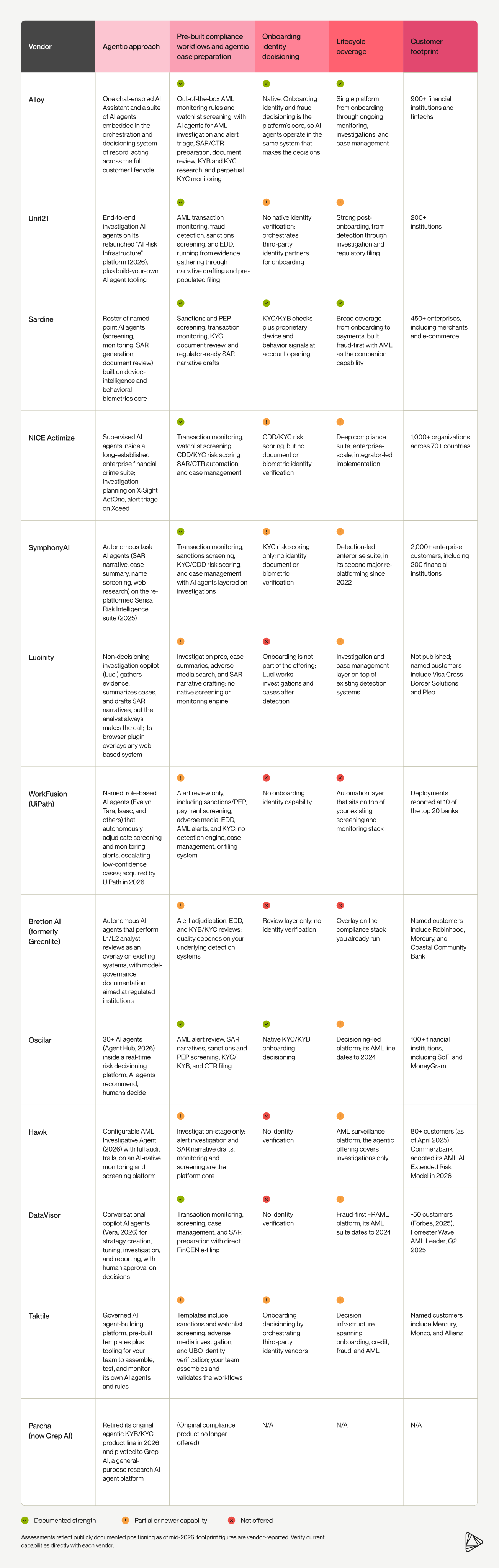
Leading agentic AI solutions for financial compliance in 2026 include Alloy, Unit21, Sardine, NICE Actimize, SymphonyAI, ComplyAdvantage, Lucinity, and WorkFusion, along with a newer generation of AI agent-first vendors that include Bretton AI (formerly Greenlite), Oscilar, Hawk, DataVisor, Taktile, Parcha, and Socratix AI.
They come from very different starting points (e.g., orchestration and decisioning, investigation tooling, device intelligence, enterprise detection suites, screening data, and workflow automation), and that heritage shapes what each does best.
This comparison is based on each vendor's current publicly documented capabilities, production claims, and product positioning as of mid-2026, assessed against the six criteria above.
It focuses on solutions that ship pre-built compliance capabilities. General-purpose AI agent frameworks with no pre-built compliance content were excluded.
While Alloy publishes this guide, we've kept the competitor assessments factual and verifiable, because a comparison you can't trust isn't worth your time. Performance figures are vendor-reported unless otherwise noted.
Think we got something wrong, or shipped something new since we last checked? Tell us at [email protected]. If we can verify it, we'll update the guide.
Alloy is the AI-powered identity and fraud prevention platform trusted by more than 900 of the world's leading financial institutions and fintechs. It was built as an integrated system of three layers:
That architecture is what makes Alloy's agentic AI reliable, credible, and governable. It operates on the same data, policies, and customer history as your end-to-end identity and fraud prevention workflows, ensuring it's making full-context recommendations informed by deep, centralized data and your actual decision logic.
For compliance specifically, Alloy's AI agents have pre-built skills for watchlist screening (sanctions, PEP, adverse media, and warnings), AML investigation, fraud alert triage, SAR and CTR preparation, document review, KYB and KYC research (including UBO corroboration and consumer due diligence), and perpetual KYC monitoring, each producing a transparent audit trail in the same record. Alloy also builds for our clients' most complex use cases, extending agentic solutions to the specific problems their teams need solved.
Best for: Financial organizations that need production-ready agentic AI for both compliance operations and fraud detection, and want one orchestration engine, one data context, and one audit trail powering both (rather than separate tools that don't share signals).
Unit21 rebuilt its platform around agentic AI and relaunched in March 2026 as "AI Risk Infrastructure," with out-of-the-box AI agents for AML transaction monitoring, fraud detection, sanctions screening, and EDD, plus a Build Your Own Agents capability and an Agentic Task Builder for custom investigation logic. Its AI agents execute investigations end to end, from evidence gathering through narrative drafting and pre-populated regulatory filings, all with human review.
Unit21's strength is its depth in the investigation workflow. Its alert triage, case management, and SAR preparation are mature and well-regarded. It does support onboarding verification by integrating third-party identity partners like Persona, Trulioo, and Middesk, but its center of gravity is post-onboarding monitoring and investigation.
Best for: Organizations whose primary pain is investigation workload in fraud and AML operations, and who already have identity and onboarding decisioning handled elsewhere.
Sardine positions itself as an agentic risk platform built on device intelligence and behavioral biometrics, with a roster of named AI agents that now spans sanctions screening, PEP screening, transaction monitoring, KYC document review, SAR generation, OSINT search, business due diligence, and graph analysis. Its foundation is one of the industry's largest device and behavioral data networks (the company reports more than 6 billion profiled devices), which powers real-time fraud detection at onboarding, login, and payment.
Sardine's detection layer is its standout. It offers proprietary device and behavior signals that most competitors can't replicate, all enriched by consortium intelligence. Its compliance operations tooling includes case management with SLA tracking and two-eyes review, plus regulator-ready SAR narrative drafts compiled from case findings and automated SAR filing direct to FinCEN.
But the platform is built fraud-first, with AML compliance as the companion capability. It also serves merchants and e-commerce alongside financial organizations rather than specializing in regulated-institution compliance operations.
Best for: Organizations whose top priority is real-time fraud detection quality (especially device- and behavior-driven threats) with agentic ops automation as a growing complement.
NICE Actimize is the enterprise financial crime incumbent, with a claimed 1,000+ organizations across 70+ countries running its AML, fraud, and case management software. In April 2025 it introduced agentic AI on both of its platforms.
Actimize's strength is the depth and regulator familiarity of its pre-built catalog. Transaction monitoring, watchlist screening, CDD/KYC risk scoring, SAR and CTR automation, and enterprise case management are all long-established modules.
Be sure to consider the fact that deployments are enterprise-scale programs often led by systems integrators, and it does not provide onboarding identity verification.
Best for: Large financial institutions that want agentic features inside an established, examiner-familiar enterprise suite and have the resources for an enterprise implementation.
SymphonyAI's financial services division combines the NetReveal platform (acquired from BAE Systems in 2022) with its Sensa AI layer. It launched Sensa autonomous AI agents in 2025, including SAR narrative, case summary, and web research agents, with a name screening agent added to the lineup since. In October 2025, it re-platformed the portfolio as Sensa Risk Intelligence, an AI-native suite spanning detection, investigation, AI agents, and data. The company reports more than 2,000 enterprise customers, including 200 leading financial institutions.
SymphonyAI's breadth is its strength. It offers transaction monitoring, sanctions screening, KYC/CDD risk scoring, payment fraud, and case management under one vendor, with AI agents layered on investigations. Buyers should factor in that it does not provide document or biometric identity verification at onboarding.
Best for: Tier 1–2 banks and insurers that want a single enterprise vendor for detection, screening, CDD, and investigation, especially existing NetReveal customers with a sanctioned migration path.
Lucinity is an AI-native financial crime investigation platform whose AI agent, Luci, automates evidence gathering, case summarization, adverse media search, and SAR narrative drafting, with the analyst always making the final call.
Its Luci Plugin is a browser extension that overlays those skills onto any web-based compliance system, with out-of-the-box skills working without integration work. Named customers include Visa Cross-Border Solutions and Pleo, and in April 2026 Oracle secured rights to Lucinity's investigation technology to embed in its own financial crime platform.
Lucinity's center of gravity is the investigation and case management layer. Sanctions screening data comes via partners rather than natively, onboarding identity verification is not part of the offering at all, and Luci is deliberately non-decisioning; it only prepares cases.
Best for: Mid-size banks, fintechs, and payments companies that want a modern AI investigation layer or a copilot overlaid on the systems they already run, without replacing detection infrastructure.
WorkFusion, acquired by UiPath in February 2026, offers named, role-based AI agents that adjudicate compliance alerts: Evelyn (sanctions and PEP name screening), Tara (payment screening), Evan (adverse media), Edward (EDD), Isaac (AML transaction monitoring alerts), and Kayla (KYC).
These AI agents disposition routine alerts autonomously, with confidence thresholds routing anything uncertain to humans. The company reports deployments at 10 of the top 20 banks, with named customers including Scotiabank, Deutsche Bank, and Standard Bank.
WorkFusion is an automation layer, not a compliance platform. It has no detection engine, no native case management or filing system, and no onboarding identity capability. Its AI agents sit on top of your existing screening and monitoring stack.
Best for: Large and midsize banks with high screening alert volumes that want measurable first-line alert review automation on top of existing systems
Beyond the platforms above, several newer or adjacent vendors show up in agentic compliance evaluations:
The fastest way to separate production-ready AI agent solutions from polished demos is to ask questions that can only be answered with concrete numbers and evidence. Use the following questions on sales calls and in RFPs to inform your vendor evaluation process.
There are four reasons Alloy is a leading choice for financial organizations that need AI agents for compliance:
Let’s look at each in more detail.
Alloy provides a cross-platform AI Assistant that interprets Alloy’s structured decision context to explain why an application, alert, or investigation is in its current state, with an advanced chat feature that lets users ask questions to make faster decisions. Alloy’s specialized AI agents perform operationally heavy fraud and compliance tasks, including fraud and AML investigation prep, watchlist hit triage, and KYB and KYC research, across every stage of the customer lifecycle.
And critically, every action is captured in a complete audit trail.
Alloy's machine learning models and AI Assistant operate on the same data, policies, and customer history as financial organizations’ end-to-end identity and fraud prevention workflows. This allows them to reference real policies, past actions, and customer history to make decisions rather than inferring context from case output.
That context draws on rich identity signals and behavioral insights from Alloy's network of 300+ partner solutions (the largest in the industry), which Alloy unifies under a central interface; you can even bring your own third-party and internal AI models to the platform. Whereas standalone AI agents inherit the blind spots of fragmented data, an AI agent embedded in the system of record, like Alloy’s, has a more complete understanding of risk.
Alloy ships with out-of-the-box rules built from industry best practices, including AML monitoring that screens for typologies such as structuring, money-mule activity, and funneling. Alloy's AI agents then work the alerts those rules generate. It is built for non-predictive tasks that involve many interconnected steps, from suspicious activity reports to complex KYB investigations, and it features six specialized skills that automate the compliance work that otherwise consumes analyst time:
It also features built-in controls, explainability, and auditability that support human oversight, so when an edge case needs to be routed to an analyst, they have full visibility and everything they need to run an efficient review. In effect, the AI Assistant and AI agents enable your compliance operations to scale without scaling costs.
More than 900 of the world's leading financial institutions and fintechs run on Alloy, and the operational outcomes are specific:
As Edward Campiani, Chief Compliance Officer at EDGE, put it: "Alloy's AI agent saves me a significant amount of time and gives me the confidence to quickly review and close watchlist alerts based on the insights it provides."
Alloy also runs a structured 30–90 day proof-of-concept framework, back-testing AI agent decisions against your team's historical decisions and running shadow journeys in a parallel production environment. This allows you to validate performance against your own SOPs before committing.
Alloy is not the best choice for very early-stage fintechs that haven't yet reached the application and alert volumes where agentic automation pays for itself. The ROI of AI agents comes from absorbing review volume, and if a small risk team can clear the queue by hand each day, an enterprise platform like Alloy is a solution ahead of its problem. Other signs you would be better served by a different solution include:
In general, the right time to evaluate Alloy is when manual review starts constraining your growth, and queue depths, times-to-decision, or headcount become a bottleneck.
The term "best" is subjective and circumstance-dependent. Alloy is a leading provider of AI agents for financial compliance because its AI agents run on pre-built compliance workflows for AML alert triage, SAR preparation, watchlist screening, and perpetual KYC across the full customer lifecycle, all built into the platform trusted by more than 900 of the world's leading financial institutions and fintechs. Unit21, Sardine, NICE Actimize, SymphonyAI, ComplyAdvantage, Lucinity, and WorkFusion are strong alternatives for narrower investigation-, detection-, screening-, or alert-review-focused needs, and emerging vendors like Bretton AI, Oscilar, Hawk, and DataVisor are worth watching.
Evaluate AI compliance agents on six criteria: pre-built compliance workflows and agentic case preparation, integration depth and data context, human-in-the-loop controls, model risk management support (including explainability and audit trail quality), lifecycle coverage, and production track record with regulated institutions. Ask every vendor for an actual audit log and verified automation metrics from production clients.
Rule-based automation executes predefined logic. If a threshold is crossed, it triggers a fixed action. AI agents reason. They gather evidence, weigh conflicting signals, generate case narratives, and recommend or execute next steps, with humans reviewing rather than re-investigating. Rule-based automation works well for deterministic thresholds, while agents excel at investigation work and pattern recognition. In practice, the two work together; rules decide what gets flagged, and AI agents work the resulting alerts, collating the evidence so analysts review a prepared case.
Pricing is typically custom, based on application or alert volume, workflows deployed, and institution size, and vendors generally don't publish rates. Total cost should include integration effort and model risk management validation, which is why platforms with pre-built workflows and native lifecycle coverage often cost less to operate than cheaper point solutions stacked together.